How Much Can You Earn Washing and Protecting Cars?
You love making cars shine, but you’re not sure if that passion can pay the bills or grow into a real business.
This guide breaks down the real numbers, from weekend side income to a full operation. We will cover realistic income ranges, how to structure your pricing, and what to charge for everything from a basic wash to paint correction and ceramic coating.
Without a clear plan, you risk working hard just to break even, leaving money and customers on the table for someone else.
Key Takeaways: A Real-World Snapshot
Before we get into the weeds, here is a clear look at what solo operators can realistically expect to earn. Remember, these numbers represent gross revenue, not the money you take home.
| Business Model | Hourly Revenue Range | Daily Revenue Range (Solo) | Annual Revenue Range (Est.) |
|---|---|---|---|
| Mobile Detailing | $40 – $80 | $160 – $400 | $30,000 – $60,000 |
| Shop-Based Detailing | $60 – $120 | $240 – $600 | $40,000 – $80,000 |
| Specialized (Paint Correction, Coatings) | $100 – $200+ | $400 – $800+ | $60,000 – $120,000+ |
The income you see advertised is almost always revenue, not your salary. It’s the total cash coming in before you pay for chemicals, towels, insurance, and everything else.
From my own shop, the biggest leap in earnings came when I moved from basic cleans to paint correction and ceramic coatings. Specializing in high-skill services is the single fastest way to increase what you earn per hour.
The Real Numbers: How Much Car Detailers Get Paid
So, how much do car detailers make? For a solo detailer running their own show, here are concrete, conservative ranges based on what I’ve seen and lived.
- Per Hour: $25 to $50 in actual take-home pay is common after costs. Your billed rate might be higher, but this is what often lands in your pocket.
- Per Day: A good, efficient day might net you $150 to $300 for your labor. A great day with a big job can hit $500.
- Per Year: A dedicated solo detailer often ends the year with a personal income between $30,000 and $70,000.
Let’s break down a $200 interior detail job. You charge $200. Right off the top, you spend about $15 on specialized cleaners and conditioners for different surfaces. You use $3 worth of microfiber towels you’ll need to replace soon. Your monthly insurance, website, and vehicle costs might add another $15 to this single job. Your pay for that $200 job is closer to $167. Understanding professional car interior cleaning cost is essential for fair pricing and healthy margins. This breakdown shows where those costs live in a typical interior detail. This gap between the price tag and your pay is the most critical thing to understand in this business.
Location changes everything. In the USA, there are over 100,000 detailing businesses. Competition is fierce in some areas, which can push prices down. Compare that to a query like “car detailing business income in india,” where labor and overhead costs are lower, but so are the prices you can charge. A top detailer in Mumbai might earn a good local living, but the dollar figures are vastly different.
What Does a “Day’s Pay” Actually Look Like?
Picture two very different days. Day one is basic wash and wax services. You might handle three sedans at $120 each. That’s $360 in revenue for 6-7 hours of solid work.
Now, day two. You have one appointment: a paint correction on a jet black BMW 3 Series, my “Swirl Magnet.” The owner wants the holograms and spiderwebs gone. This job takes me 8 hours from setup to final wipe. I charge $800 for it. That one car, in one day, earns more than twice the revenue of the three basic jobs. The work is more mentally and physically demanding, but the pay reflects the skill required.
This gets to the heart of “how many cars should I detail in a day.” For quality work, especially corrections or coatings, the answer is often just one. Your body and your attention to detail have limits. Rushing to do more cars usually means doing worse work. When combined with frequent sessions, it’s important to know how often you should detail a car to maintain its condition.
The Big Split: Revenue vs. Profit
When you ask “how much car detailer make,” you must think about what gets taken out first. These are the silent costs that eat into every job.
- Chemicals: Soap, degreaser, all-purpose cleaner, dressings, compounds, polishes.
- Consumables: Microfiber towels (good ones cost money), polishing pads, clay bars, applicators.
- Overhead: Liability insurance, business license, fuel for your mobile rig, website hosting, marketing ads.
- Equipment Wear: Your polisher, vacuum, extractor, and pressure washer all need maintenance or replacement.
The formula is simple, but you have to use it: Job Price – Cost of Goods – Overhead = Your Pay.
Cost of Goods is what you used on that specific job (chemicals, a portion of a towel). Overhead is your monthly business costs divided by your number of jobs. If you ignore this math, you will wonder where all the money went.
Setting Your Rates: Pricing Models That Work
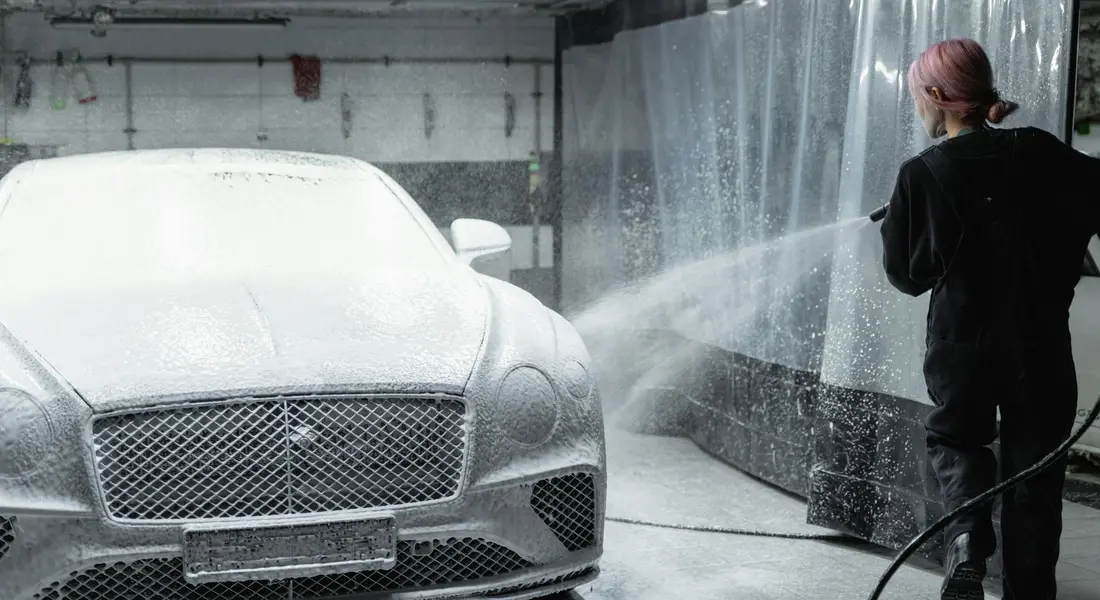
You need to move beyond guessing. I build my rate sheet from the ground up by treating each service like a recipe with fixed costs. Write down every step, from foam cannon shampoo to final wipe down, and attach a real cost in products and minutes to it.
New detailers often fixate on how much car detailers charge per hour. Hourly rates make sense for unpredictable work, but they punish you for getting efficient. A flat rate package, like a $199 Express Detail, gives the customer clarity and rewards your speed. Flat rate pricing builds immediate trust because the price is set before the first spray bottle is squeezed.
I always advocate for value based pricing. This means you charge for the transformation, not the time. When a client sees their dusty Honda Odyssey interior go from sticky chaos to a fresh, clean space, they are paying for that feeling. Your price should mirror the value you deliver, not just the hours you log.
The Three Core Pricing Strategies
Use these three models to structure your service menu. They cover every type of customer.
Package Pricing (Good, Better, Best): This is my backbone. Offer three clear tiers. For instance, Good is a wash and vacuum, Better adds a spray wax, Best includes interior shampooing. It makes decision easy and guides customers up. I use this on my Odyssey the “Kid Hauler” with a base clean and odor treatment as a top tier add on.
A La Carte Menu: Some customers have one specific need. They might just want the brake dust cleaned off their Porsche 911 wheels or a clay bar treatment for their Ford F 150’s hood. An a la carte menu caters to precise problems without the pressure of a full package.
Hourly Rate for Special Projects: This is essential for unknowns. A multi stage correction on a swirled black BMW or extracting a deep set stain from a seat can take longer than planned. An hourly rate, like $80 to $120 per hour, protects your income when the job scope is a mystery.
What to Charge for Common Services
Here are realistic price ranges from my shop, using our familiar vehicles for scale. Adjust for your local area.
Basic Interior/Exterior Detail (Honda Odyssey): This is a thorough clean inside and out. For a minivan like my Odyssey, with its crushed crackers and sticky consoles, it takes 2.5 to 3.5 hours. I charge $175 to $275. The price accounts for the larger interior volume and common kid related messes.
Paint Decontamination & 1 Step Polish (Ford F 150): My F 150, the “Workhorse,” needs this to fight oxidation and road film. The service includes claying, a single pass polish, and sealant. For a full size truck, budget 3.5 to 4.5 hours. Charge $350 to $500. You are selling restored shine and protection for a vehicle that sees real use.
Multi Step Paint Correction (BMW 3 Series, Porsche 911): This is for severe swirls, scratches, and holograms. My black BMW is the classic case. This illustrates the car paint correction process in action—targeted defect removal to restore clarity and depth. A two step correction (cut then refine) can take 8 to 15 hours depending on paint hardness. For a midsize sedan, charge $850 to $1,600. For a high end sports car like the 911, $1,300 to $2,500. The precision required and the vehicle’s value command a premium price.
Ceramic Coating Application (Tesla Model 3): This includes a full correction prep, then applying the coating. My Tesla, with its soft clear coat, required a full day of focused work. For a midsize car, charge $1,200 to $2,200. Understanding this professional ceramic coating cost helps you budget effectively and compare quotes. In the next steps, a breakdown of cost drivers and example quotes will be provided to help you assess value. The cost reflects the premium materials and the years of protection you are applying.
Interior Deep Clean & Odor Treatment (Honda Odyssey): This involves extraction, scrubbing, and possibly an ozone generator. For a minivan with spilled milk history, it takes 4 to 6 hours. Charge $325 to $550. Eliminating deep set odors and stains provides immense value to a family.
Quick Snapshot: Service Rate Ranges
This table answers “how much should I charge for detailing a car” visually.
| Service | Vehicle Size Example | Time Estimate | Price Range |
|---|---|---|---|
| Basic Interior/Exterior Detail | Honda Odyssey (Minivan) | 2.5 3.5 hours | $175 $275 |
| Paint Decontamination & 1 Step Polish | Ford F 150 (Full Size Truck) | 3.5 4.5 hours | $350 $500 |
| Multi Step Paint Correction | BMW 3 Series (Midsize Sedan) | 8 12 hours | $850 $1,600 |
| Ceramic Coating Application | Tesla Model 3 (Midsize EV) | 6 8 hours (plus prep) | $1,200 $2,200 |
| Interior Deep Clean & Odor Treatment | Honda Odyssey (Minivan) | 4 6 hours | $325 $550 |
Calculating Your Costs & Your Price
This calculation is the heart of your car detailing business income. If you do not know your costs, you cannot know how much money you can make owning your own detailing business. Let’s walk through it together.
Step 1: Add Up Your Product & Supply Costs
Track every consumable used in a standard detail. For a sedan interior/exterior, my costs look like this:
- Car Shampoo: $0.75
- All Purpose Cleaner: $1.00
- Iron Remover & Clay Lube: $2.50
- Quick Detailer/Spray Wax: $0.50
- Microfiber Towels (4 5, cost per use): $3.00
- Brushes, Applicators: $0.75
That’s roughly $8.50 in consumables. This number shifts with your product tier. Budget chemicals from a retail store cost less upfront but can dilute easily or lack cleaning power, forcing you to use more. Professional grade products, like the compounds I use on my Porsche, cost more per ounce but work faster and last longer. Using professional products often lowers your cost per job because you use less and get better results.
Step 2: Factor In Your Overhead & Time
Overhead is your monthly cost of doing business. It includes:
- Vehicle payment or lease for your work vehicle
- Business insurance and liability coverage
- Software for booking and invoices
- Marketing, website fees, and phone bill
- Equipment replacement fund (for polishers, vacuums)
If your monthly overhead is $600 and you complete 25 jobs, that’s $24 of overhead cost per job.
Now, set your hourly labor rate. This is how you determine how much do car detailers get paid by you, the owner. Do not undervalue your skill. Aim for an hourly wage of $35 to $60 based on your expertise and local rates. If a job takes 3 hours and your target rate is $45, your labor cost is $135. That balance between value and wage helps a car detailing business stay profitable. Smart pricing fuels sustainable growth and margins.
Step 3: The Simple Math to Set Any Price
Here is the formula: (Supply Cost + Overhead Cost) + (Your Hourly Rate x Job Hours) = Your Minimum Price.
For a Basic Detail: Supplies ($8.50) + Overhead ($24) + (Labor $45 x 3 hours = $135) = $167.50. Your minimum price is about $168. This number ensures you cover every cost and pay yourself a fair wage.
This minimum is your break even point. Your actual price sits above it. Market demand and your proven skill let you charge more. If you specialize in restoring single stage paint like on my Miata, you can charge a premium for that rare expertise. Your reputation for exceptional results is what turns a minimum price into a profitable one.
Boosting Your Income: What Makes the Most Money
You do not make the most money washing the most cars. You make it by doing the most valuable work for each car. Chasing ten basic wash jobs will burn you out and fill your schedule with low pay. The real money is in transforming one car so thoroughly that the owner sees it as an investment, not an expense. Your goal is to move from a service provider to a trusted craftsman.
The High-Profit Service Pyramid
Think of your services as a pyramid. The base is wide and necessary, but the peak is where you find your profit and reputation.
- Base Tier (Volume, Low Margin): Basic exterior washes, quick interior vac & wipe. These are entry points, often priced to compete with drive-thrus. Material cost is low, but so is the price you can command.
- Middle Tier (Solid Profit): Full interior details with extraction, two-bucket hand washes with spray wax, basic paint decontamination (clay bar). This is your bread and butter as a serious detailer. The time investment is higher, but so is the fee.
- Upper Tier (High Margin): Paint correction (one-step or multi-stage), ceramic sealant applications, full interior sanitization & odor removal. Here, your expertise is the product. The chemicals and pads are cheap compared to the hundreds, or thousands, you charge for your skilled labor.
- Peak Tier (Maximum Value): Paint Protection Film (PPF) installation and professional-grade ceramic coatings with multi-year warranties. This is the summit.
My red Porsche 911, the “Garage Queen,” is the perfect example. Its owner did not ask for a wash. They wanted their investment preserved. A full front-end PPF install or a full-body ceramic coating on a car like that is a $2,000 to $5,000 job. The film or coating itself is a fraction of that cost. The vast majority of your fee is for your certified skill, your steady hand, and your guaranteed, dust-free workspace—regardless of how much they paid to wash or clean their car’s exterior.
Vinyl wrapping and window tinting sit alongside PPF at this peak. They are highly specialized, visible skills. A full color-change wrap can command $3,000 to $6,000. They are not strictly “detailing,” but they attract the same clientele who values perfection and is willing to pay for it.
The Power of the Inspection & The Add-On
The single greatest tool for boosting your income is not a polisher. It is your inspection light and your ability to communicate what you see. Never start work without the customer present for a walk-around in good light, preferably sunlight.
Run your finger over the paint. Is it gritty? That’s bonded contamination, a chance to sell a clay bar service. Shine your light across the hood of a black car, like my BMW “Swirl Magnet.” Those spider-webs are not clean. Show the customer the swirls under your light, then make them disappear with a test spot on their hood. That demonstration sells paint correction every time.
Look at the single-stage paint on my old Mazda Miata. It’s gone pink and chalky. Explain that a compound and polish will bring the red back to life. This moves the job from a “$150 wash and wax” to a “$600 paint restoration.”
Beyond the big jobs, have a list of high-profit, low-time add-ons ready:
- Headlight Restoration: 30 minutes of work, $80-$150. Cloudy lights are a safety issue and make any car look old.
- Fabric & Carpet Guard: After a deep clean, applying a protectant is a 10-minute upsell that adds $50-$100 and helps the customer keep it clean.
- Engine Bay Detail: A degrease, gentle clean, and dressing. It impresses at car shows and resale. A straightforward $75-$150 add-on.
- Trim & Plastic Restoration: Faded bumpers and trim on a clean car stand out. A permanent trim coating is a fantastic, high-value service.
Building a Business, Not Just a Job
There is a ceiling on how much one person can polish in a week. To break past it, you must think like a business owner.
The first step is often hiring a helper. You handle the inspection, correction, and coatings. They do the wash, vac, and tire dressing. This doubles your capacity. You can now book two cars in a day, or tackle a large RV or boat.
Next, consider specialization. You might become the “paint correction and coating” expert in your region. You stop offering basic washes entirely. Your marketing, your van, your whole brand screams expertise. Your Porsche 911 clients find you, and they only want that top-tier service.
Building commercial accounts is another path to stable, scaled income. A local dealership might need three to five cars detailed daily for their lot. The per-car fee is lower, but the volume is guaranteed. A fleet manager for a small business might want their five work trucks deep cleaned quarterly. This is predictable income that fills your schedule during slower times.
The solo operator working hard can make a good living. The business owner working smart, leveraging skills and other people’s time, defines their own income. It starts with choosing to detail one car for $1,000 instead of five cars for $200 each.
Making It Work For You
At the end of the day, your detailing income isn’t just about what you charge per hour. It’s about how you turn your skill, time, and passion into sustainable profit. Focus on creating service packages that make sense for your market and pricing them so you’re paid fairly for your expertise and effort.
If you don’t price with intention, you’ll quickly find yourself trading your weekends for a hobby wage instead of building a real business.
Research and Related Sources
- r/smallbusiness on Reddit: How much money are car washes making?
- How Profitable is a Car Wash? Unlock Business Success – NCS National Carwash Solutions
- Car Wash Profits & Costs: 2024 Data from 280+ Businesses