What’s the Real Difference Between a Buffer and an Orbital Sander for Your Car?
Reach for the wrong tool and you could turn a simple wax job into a permanent, cloudy mess on your paint. I see this confusion all the time in my shop.
We will cover how each tool physically works on your clear coat, the exact detailing jobs they are built for, the critical safety steps to prevent damage, and my simple rule for choosing the right one.
Using an orbital sander like a polisher will instantly scratch your finish down to the basecoat.
The Short Answer: It’s a Detailer vs. Carpenter Tool
An orbital sander is built to aggressively remove material like wood or body filler. A car polisher, often called a buffer, is engineered to safely refine and protect a delicate painted finish.
This table shows the core differences at a glance.
| Feature | Orbital Sander | Car Polisher/Buffer |
|---|---|---|
| Orbit Size | Fixed, small (often 1/16″ to 3/32″) | Larger, variable (often 8mm, 15mm, 21mm) |
| Speed Range | Lower RPM (8,000 – 14,000 OPM common) | Wider, controlled RPM range (1,500 – 7,000+ OPM) |
| Typical Use | Woodworking, metal prep, bodywork | Paint correction, polishing, applying waxes & sealants |
| Risk to Paint | Very High. Can burn, haze, or gouge clear coat. | Low to Moderate. Designed for safe paint interaction. |
My firm advice is to use the right tool for the job. For anything related to polishing or protecting your car’s paint, you need a purpose-built car polisher. Trying to use an orbital sander is a shortcut that almost always ends with a costly repair bill. I learned this lesson years ago on my black BMW, and I’ll explain exactly why.
What Exactly is an Orbital Sander? (The Woodshop Tool)
You find this tool in a workshop, not a detailing bay. Its natural habitat is a bench surrounded by sawdust, where it sands down a rough piece of wood or levels a patch of body filler on a fender. The motion is a tight, fixed orbit. This small, aggressive circle is designed for one thing: fast material removal.
Key specs give away its purpose. Orbital sanders typically run at lower speeds, measured in oscillations per minute (OPM), to maintain control on rough surfaces. They use a standard 5/8″ or a six-hole pattern for attaching sanding discs. This is a key point. That attachment is meant for abrasive paper, not the soft foam or wool pads we use in detailing.
This leads directly to the big question I get from DIYers.
Can you use an orbital sander to polish your car? Technically, yes. You can screw a foam buffing pad onto one. But you should not. It is a high-risk, inefficient method that can ruin your paint, especially when attempting to cut and polish car paint scratches.
Here’s why. First, the fixed, small orbit creates intense, focused friction. On car paint, this generates heat incredibly fast. Heat is the enemy of your clear coat. Second, the speed control is crude. It’s not designed for the finesse needed to break down a fine polish. You’ll likely leave behind a hazy, swirled mess known as holograms, which is exactly what I fight to remove from my “Swirl Magnet” BMW. Finally, it lacks the ergonomics and balance of a polisher. It’s tiring and clumsy to use on vertical panels.
When an Orbital Sander *Might* Touch a Car
There are a few specific, non-polishing jobs where this tool has a place in automotive work. These are restoration or repair tasks, not part of a regular wash and wax routine, and certainly not polishing car paint by hand or machine.
- Sanding Rust: Removing surface rust from a metal part before applying primer and paint.
- Leveling Body Filler: Smoothing a repaired area on a body panel before it gets primed.
- Restoring Single-Stage Paint: This is a special case for classics. My 1995 Mazda Miata has single-stage paint, meaning no separate clear coat. In a full restoration, you might use a sander with very fine grits (like 2000+) to level severe oxidation before compounding. This requires extreme caution and is not for beginners.
Each of these uses involves material removal, not finishing. Once you reach the priming or painting stage, the orbital sander’s job is done, and the polisher’s work begins. For 99% of car owners, an orbital sander should stay in the garage for its intended projects, far away from your vehicle’s finish.
What Exactly is a Car Buffer or Polisher? (The Detailer’s Tool)

You hear the words buffer, polisher, and dual action polisher tossed around. In our world, they usually point to the same tool. It’s not the orbital sander from your woodworking bench. A car buffer is a specialized electric tool designed for one job: working paint to a perfect finish.
Its motion is the key. A proper polisher uses a random orbital or a forced rotation dual-action movement. Imagine your hand making tiny, overlapping circles while also jiggling randomly. This motion generates the friction and heat needed to break down polish and remove defects, but it’s designed to dissipate that heat quickly. This design drastically reduces the risk of burning through your car’s delicate clear coat, which is the nightmare scenario every detailer avoids. When you compare a DA polisher vs a rotary polisher, the heat management and finish-control dynamics shift. Understanding those differences helps you choose the right tool for the job.
When you look at a polisher, check a few key specs. You want variable speed settings, typically measured in oscillations per minute (OPM), ranging from about 1,000 to 6,000 or more. A standard 5-inch or 6-inch backing plate is common, using a hook-and-loop system to attach foam or microfiber pads. My go-to machine, the one I use on my black BMW and the red Porsche, has a 5-inch plate. It’s the right size for control and power on most panels.
One question I get all the time: can you use a buffer to wax your car? The answer is a definitive yes. In fact, once you try it, you’ll never go back to hand-applying wax. Mastering car waxing techniques—pad choice, speed, and product—will help you get consistent, flawless results across any finish. Using a clean, soft finishing pad on a low-speed setting is the fastest way to get a perfectly even, thin layer of wax or sealant on your paint. For my F-150’s large hood or the Tesla’s big roof, it saves my arms and ensures no spot gets missed. You can even use the same machine on a low setting to buff off the dried residue, though I often still do that final wipe by hand with a plush microfiber.
The Two Main Types: DA vs. Rotary
There are two main breeds of machine polisher, and choosing the right one is critical for your paint’s safety.
The Dual Action (DA) or random orbital polisher is the one I recommend to everyone starting out. It’s what I used to correct the brutal swirls on my Jet Black BMW. The backing plate spins in a circle, but the entire assembly also oscillates in a random orbit. This random action is your safety net. Even if you hold the pad in one spot too long, it’s very difficult to generate enough concentrated heat to burn the paint or create holograms (those nasty swirl-like marks left by an untrained hand with a rotary).
The Rotary buffer is the professional’s tool. It spins in a single, unwavering circular motion, like a spinning top. This creates intense, focused friction and heat. In skilled hands, a rotary can remove severe defects faster than a DA. But there is no safety net. If you linger on an edge or a curve for just a second too long, you can burn straight through the clear coat in a heartbeat, requiring a repaint. I keep a rotary in my shop for specific, tough jobs on single-stage paint like my old Miata, but I would never hand one to a friend learning to detail.
For the 99% of car owners and home detailers, a quality DA polisher is the only tool you need. It’s safe, effective, and forgiving. It lets you focus on learning proper technique-pad pressure, arm speed, product choice-without the constant fear of ruining your car’s paint. That peace of mind is everything, especially compared to hand polishing.
Side-by-Side: Why You Can’t Swap Them Safely
It looks like a simple tool swap. Both machines spin. Both have a backing plate. But trust me, using one for the other’s job is a fast track to ruining your car’s finish. I learned this the hard way on a fender years ago. Let’s break down why they are built for completely different worlds.
Orbit Pattern: The Path to Destruction vs. Perfection
This is the most critical difference. An orbital sander has a fixed, predictable orbit. The pad spins in a tight, consistent circle. This is brilliant for evenly removing material like wood or primer. On car paint, that consistent path will instantly create a perfectly circular, deep scratch pattern called holograms or buffer trails.
A dual-action polisher, or buffer, has a random orbital path. The pad spins, but the entire head also oscillates in an erratic pattern. This randomness is what allows abrasives to gradually level clear coat swirls without leaving a single, definitive scratch behind. Think of it like this: a sander digs a neat trench, while a polisher gently erases footprints from sand. For my black BMW, the “Swirl Magnet,” using anything but a true random orbit polisher is an invitation for disaster.
Speed & Power: Brute Force vs. Controlled Finesse
Orbital sanders are torque monsters. They’re designed to power through resistance, like grinding down old paint or leveling wood. Their motors are built for constant, high-load work. They often have a single, very fast speed.
Car polishers are all about control. You need variable speed settings, usually from about 600 to 3,500 RPM (or OPM for orbital strokes per minute). Lower speeds are for spreading product. Medium speeds work the polish. Higher speeds are for cutting. The motor is engineered to manage the hydraulic friction of liquid polishes and soft foam, not the gritty, constant drag of sandpaper on wood. Using a sander’s brute force on polish will fling product everywhere and burn through your clear coat in seconds.
Heat Generation: The Paint Burning Point
Friction creates heat. An orbital sander, with its aggressive fixed orbit and high torque, generates intense, focused heat very quickly on a small, hard surface. On car paint, this heat doesn’t dissipate. It builds up in one spot, cooks the clear coat, and causes a paint burn. A burn looks like a cloudy, discolored patch you cannot fix. It requires a repaint.
A proper polisher is designed to manage heat. The random orbit spreads friction over a wider area, and the soft foam pad acts as an insulator. You still must keep the polisher moving, but the tool itself helps prevent that catastrophic, focused hot spot. Holding a sander in one place for three seconds can burn paint. Holding a polisher correctly gives you a safe window of 10-15 seconds of work time per section.
Pad Systems: Designed for Grit vs. Gloss
Look at how each tool holds its working surface. An orbital sander has a rigid, flat plate with a mechanical clamp or hook-and-loop system designed to grip abrasive sandpaper sheets or discs. The interface is hard.
A car polisher uses a flexible backing plate, usually made of plastic or soft rubber, which then attaches to a thick foam or microfiber pad. This entire soft system is crucial. It conforms to your car’s curves and cushions the abrasive action. You cannot safely or effectively attach a soft foam polishing pad to a sander’s plate, and you should never clamp sandpaper to a polisher’s backing plate. The forces involved will destroy the pad or cause the sandpaper to fail dangerously.
Your FAQ: “Can I Use My Car Buffer as a Sander?”
The short, firm answer is no. You should not. Let’s say you want to sand down some primer on a project car fender off the vehicle. It seems handy to grab your polisher. Don’t do it. First, the motor isn’t built for the constant, grinding torque of sanding. You will overheat and likely kill the motor. Second, the spindle and bearing aren’t designed for the side-to-side pressure of sanding. You’ll cause premature wear and a costly wobble. Finally, as mentioned, the backing plate isn’t meant for it. You risk the sandpaper disc detaching at high speed, which is a serious safety hazard for you and anything nearby. Keep the tools separate. Your polisher is an investment in your paint’s beauty. Your sander is a tool for prep work. They are different for excellent reasons.
Safety and Common Mistakes to Avoid
This is where the rubber meets the road, or more accurately, where the tool meets the paint. A single mistake here can’t be undone with a quick wipe.
The Sander is Not Your Friend
Using an orbital sander for polishing is like using a chainsaw to trim your fingernails. The damage is immediate and catastrophic. I’ve seen it happen in shops, and the result is always the same.
You will instantly haze the clear coat, creating a foggy, scratched surface that looks worse than any oxidation. The sanding pad’s abrasive material is designed to remove material, not refine it. It digs deep, leaving scratches you can feel with your fingernail.
The worst case is burn-through. Your car’s paint is a thin, layered system: clear coat, color, primer, metal. A dual-action polisher is designed to work the clear coat safely. A sander, even with a light touch, can cut straight through the clear and into the color layer in seconds. That spot is now ruined and requires a professional repaint. This is a risk especially when wet sanding car paint is not done properly.
Polisher Protocol: The Rules of the Road
Even with the right tool, you need the right technique. Treat your polisher with respect when you repair or polish scratches. Here is your non-negotiable safety checklist.
- Always Use a Clean Pad: A dirty pad is a scratch factory. Cured product and old paint residue become embedded grit. Have multiple pads on hand and swap them often.
- Start on the Lowest Speed: Never slam a spinning pad onto the paint. Place the polisher flat on the surface, *then* trigger the switch to the slowest setting. Spread your polish or wax evenly before increasing speed.
- Keep the Pad Flat: Angling the polisher focuses all its force on the edge of the pad. This creates “buffer trails” (holograms) and can overheat a tiny section of paint. Let the machine’s design do the work.
- Never Stay in One Spot: Keep the machine moving, slowly and steadily. Lingering in a single area, especially on an edge or body line, generates intense heat. Heat is the enemy of your clear coat.
- Work in small, manageable sections, about two feet by two feet. This lets you control your work and maintain a wet, workable product.
A Tale of Two Tools: The Black BMW
Let me show you why this matters. My 2016 BMW 3 Series, the Jet Black “Swirl Magnet,” is the perfect example. Its paint is soft, deep, and shows every flaw.
If I took an orbital sander to its hood, even for a moment, I would destroy it. The black would turn a milky, scratched gray. The repair bill would be thousands.
Instead, I use my dual-action polisher. With a soft foam polishing pad and a fine correcting compound, I can gently remove the fine swirls and holograms. I follow the rules: clean pad, slow start, keep it flat, keep it moving. The result is a deep, mirror-black finish that looks wet. The right tool doesn’t just do the job, it saves the paint. The wrong tool guarantees a disaster.
Technique Tweak: How to Use Each Tool Correctly
For a Polisher/Buffer
Think of your car’s panel as a small kitchen counter you’re wiping down. You work in sections. I break each door or fender into manageable areas, about two feet by two feet. This keeps the polish from drying out and lets you focus.
Start the polisher on the paint and begin moving. Your goal is slow, steady passes. Overlap each sweep by about half the width of the pad. This overlapping is what ensures you don’t leave behind any unpolished stripes or trails.
Here’s the big mistake I see. People lean on the tool. Your arm speed controls the cut, not your body weight. Pressing down too hard on my black BMW just creates heat, risks burning the clear coat, and leaves those dreaded hologram swirls. Let the pad’s rotation and the compound’s abrasives do the work. Move your arm at a consistent, deliberate pace.
You have to check your work. After a few passes on a section, stop. Take a clean, soft microfiber towel and wipe the area clean. Look at it in good light. Can you see the scratch you were trying to remove is gone? Is the haze from oxidation cleared up? This frequent inspection is non-negotiable, especially on dark paint.
For Waxing with a Polisher
Waxing with a polisher is about gentle, even application, not correction. I swap my cutting pad for a soft, clean finishing pad. On my machines, that’s usually a red or black foam pad. Using the right tools and car waxing products helps you achieve that smooth, even glow.
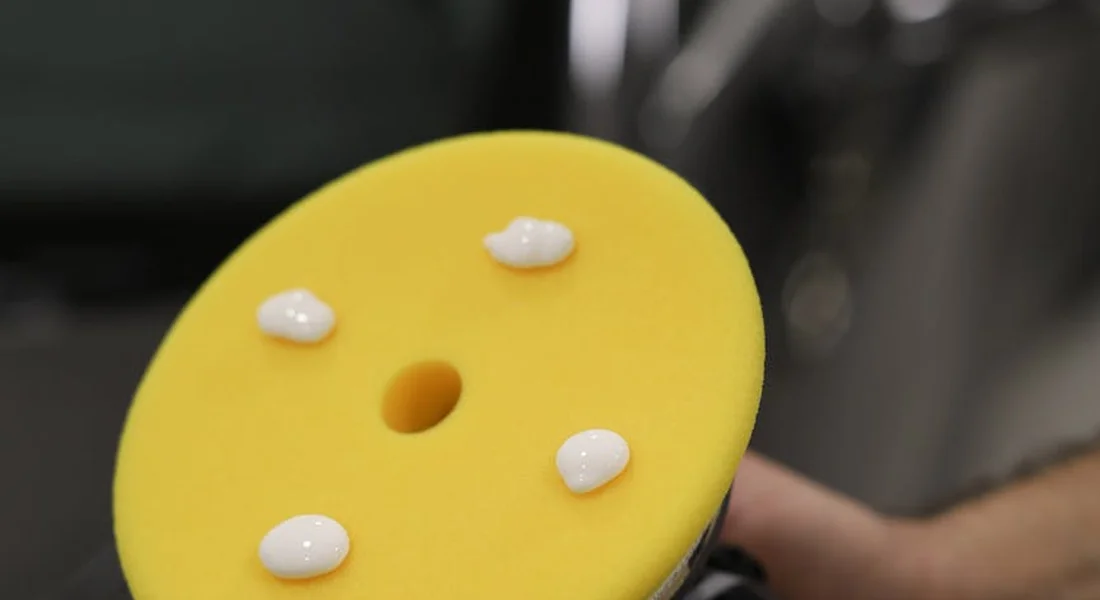
Set the speed low. I never go above setting 3 for this. High speed will sling product everywhere and make a mess. Apply your sealant or wax sparingly. I put five small dots on the pad in a starfish pattern one in the center and four around the edges.
Touch the pad to the paint and turn the polisher on to the lowest setting to spread the product. Work it in using slow, overlapping passes just like polishing, but with almost zero pressure. The goal is to lay down a thin, invisible film you can barely see. A thick layer is wasteful and a nightmare to buff off.
After spreading it over a section, turn the polisher off. Immediately grab another clean microfiber and lightly wipe the residue away. On my Tesla’s flat panels, this method gives me a perfectly even coat of protection without any streaks or wasted product.
For an Orbital Sander (On Approved Surfaces Only)
Let’s be clear. An orbital sander is for paint correction steps like wet sanding severe defects, or for sanding down primer on a restoration. It is not for your weekly wash. On my old Miata’s single-stage paint, I used one to tackle heavy orange peel before a compound.
You must use a sanding block or a firm interface pad between the sander and the abrasive disc. This keeps the surface perfectly flat. Without it, the corners of the sander can dig into the paint and leave deep, irreversible scratches.
Grit sequencing is everything. You start with a grit coarse enough to address the problem, say 1500 for a deep scratch. Then you move up in steps to 2000, then 3000. Each finer grit removes the scratches from the previous one. Jumping from 1500 straight to 3000 will leave deep sanding marks that are very hard to polish out.
Dust is your enemy. It contains hard, abrasive particles. You must vacuum the sanding dust off the surface and your sander pad after every single grit change. I keep a shop-vac hose right next to me. Letting that dust grind under your sander is a surefire way to ruin the paint job you’re trying to save.
How to Choose: A Simple Decision Guide
Listen, the goal here is to keep your paint safe. The tool you grab should match the job. I have a simple rule: when in doubt, go for the safer machine.
Use a Dual Action Polisher/Buffer if:
This is your go-to for almost all paintwork on modern cars. I use mine on every vehicle I own, from the black BMW to the red Porsche. It’s designed for the clear coat on your car’s paint, and it’s important to use the right material when painting over car paint clear coat.
- You are polishing, compounding, or waxing clear coat. The DA’s orbiting motion mimics the motion of your hand but with power and consistency. It’s perfect for applying waxes and sealants in a thin, even layer. For my F-150’s hood, a DA polisher with a finishing pad and a good sealant takes 10 minutes and leaves perfect, high-gloss results.
- You are a beginner. If you’ve never used a machine, start here. It’s forgiving. Even if you hold it in one spot a few seconds too long, it’s very difficult to burn through the paint. My first machine was a DA, and I practiced on my old Miata’s trunk lid. It’s the right choice for learning.
- You want to remove swirls from your daily driver. This is its primary job. Those fine spider-web scratches in your black car’s paint under the sun? A DA polisher with a light polish and a soft foam pad will erase them. You work panel by panel, keeping the machine flat and moving slowly. The result is a deep, clean shine without the risk of creating new, worse marks.
The process is simple: tape off plastic trim, choose the right pad and product, work in a cool, shaded area, and let the machine do the work at a moderate speed.
Use an Orbital Sander if:
I keep my orbital sander in a different toolbox, far away from my detailing cart. It’s for building and repairing, not finishing.
- You are working on a non-paint automotive project. Sanding down the wooden floor of a truck bed for a new coat of varnish? Smoothing a metal weld on a frame before primer? Flattening primer on a body panel? This is the tool. It’s aggressive and meant for material removal.
- You are restoring a single-stage paint car with deep oxidation (advanced users only). This is the one exception for paint, and it requires a lot of skill. My 1995 Miata had paint that had turned pink from oxidation. An orbital sander with a very fine grit sanding disc, used with extreme care and constant lubrication, can cut through that dead paint to reveal the good color underneath. You must follow it immediately with a DA polisher to restore gloss. If you try this on modern clear coat, you will destroy it in seconds.
For any task that involves sandpaper, you use an orbital sander. For any task that involves a foam or wool pad, you use a DA buffer.
Use Your Hands if:
Machines are great, but your hands are your most precise tool. I use them all the time for the finicky work.
- The area is too small for a machine. Think of the narrow pillars between a car’s side windows, or the tight curves around a door handle. Trying to force a 6-inch buffer pad in there will just make a mess. A small microfiber applicator block gives you perfect control.
- You are applying a quick spray wax. After I wash my Tesla, I often just use a spray wax for a fast boost. A quick spritz and a wipe with a clean towel by hand is faster than setting up a machine for such a light job.
- You are working on tight interior trim. Cleaning and protecting the dashboard around the instrument cluster, or the delicate buttons on the center console, is a hand-job. You can feel the surface and apply just the right pressure.
Compare the results on a large hood: a machine applies wax more evenly and uses far less product than your hand ever could. The machine wins for speed and finish on big, flat surfaces. Your hands win for detail work and quick touch-ups.
Securing That Mirror Finish with the Right Tool
Always use a dual-action or rotary buffer for polishing and waxing your car’s paint, as these tools are designed to safely enhance the finish. An orbital sander is meant for abrasive cutting on surfaces like wood or metal, and it has no place on your vehicle’s clear coat.
Choose the orbital sander for this job, and you will inflict deep, permanent scratches that require professional paint correction to remove.
Sources and Additional Information
- Difference between a random orbital sander and buffer. | VW Vortex – Volkswagen Forum
- Orbital Auto Paint Buffer – Complete Buyers Guide
- r/AutoDetailing on Reddit: I have a Random Orbital Sander, I e only used it for sanding but if I got the right type of pads would it work for polishing/waxing my car?
- Random orbital sander for buffing? – TeamTalk
Max Gunther
Max is an automotive enthusiast having worked as a car mechanical and in interior detailing service for over 25 years. He is very experienced in giving your old car, a new fresh vibe. He has detailed many cars and removed very tough smells and stains from all kinds of cars and models, always ensuring that his work and advice helps his customers. He brings his first hand experience to his blog AutoDetailPedia, to help readers breath new life into their car interiors.