Where to Find Expert Car Paint Scratch Repair Near You?
Seeing a fresh scratch on your car’s paint can make your heart sink. You need a skilled hand to fix it correctly, not just cover it up.
I will show you how to navigate your search, covering how to tell a detailer from a body shop, where to look for reputable services, and what questions to ask before you book.
Pick the wrong shop, and that scratch could turn into a permanent, costly eyesore.
First, Don’t Panic: What Kind of Scratch Do You Actually Have?
Before you call anyone, you need to know what you’re dealing with. A quick diagnosis saves time and money. Start with the fingernail test.
Run your fingernail gently across the scratch. If your nail catches in a groove, that’s a bad sign. If it glides over without catching, there’s hope. This simple test tells you about depth.
Think of your car’s paint like skin. A clear coat scratch is like a scraped knee. It’s surface-level, maybe from a bush or a careless shopping cart. You see a mark, but the color underneath is fine. These are the most common and completely fixable by a professional detailer. If you’re curious about how to repair car paint scratches, there are simple options to consider.
A base coat scratch is a deeper cut. Your nail will catch. You can see a distinct line of a different color-the actual paint layer is exposed. It looks white on a black car, or black on a red car. These can often be improved significantly, but perfect repair gets trickier.
A primer or metal scratch is a serious injury. Your nail drops right in. You’ll see a dark grey (primer) or silvery (bare metal) gash, often with a dent. This is a deep cut that can rust. This type of damage needs a traditional body shop, not a detailer.
Many people ask about car scratch repair kits from the parts store. Those little bottles with abrasive compounds are designed for clear coat scratches only. They work by sanding down the surrounding area to meet the bottom of the scratch. On anything deeper, you risk making a cloudy mess. I tried one on a clear coat scuff on my F-150’s bumper. It worked okay. On a deeper scratch on my old Miata’s door, it just made things worse.
Your Local Repair Options: Detailer, Specialist, or Body Shop?
Once you know your scratch, you can find the right expert. Not all shops do the same work. Picking the wrong one leads to disappointment.
Professional Auto Detailing Shops
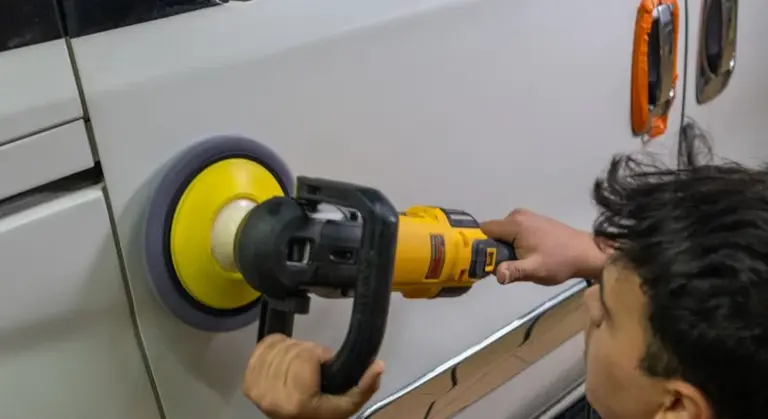
This is where I live. A professional detail shop is your first stop for clear coat scratches and many light base coat scratches. Our expertise is paint correction-using machines, polishes, and knowledge to remove defects without harming the paint.
For a clear coat scratch, we use a polishing compound on a soft foam pad. We gently abrade the clear coat around the scratch until the groove disappears. It’s like using fine sandpaper on a wooden table to remove a shallow gouge. My Jet Black BMW was covered in these from automatic car washes. A full correction made them vanish.
Most reputable shops offer a free inspection and quote. They’ll look at the scratch under good light, feel it, and tell you honestly what they can do. The vibe here is cosmetic perfection; we want your paint to look new again, not just covered up. We also handle touch-up paint blending for small chips, making them nearly invisible.
Mobile Paint & Scratch Repair Specialists
These are the handy fix-it guys who come to your home or office. They are fantastic for a single, isolated rock chip or a scratch on a door edge. The convenience is their biggest selling point.
Their methods are more advanced than a DIY kit. They use precision brushes for touch-up paint, then often wet sand the spot and polish it to blend the repair. It’s spot repair. I’ve used a mobile specialist for a nasty chip on the hood of my Porsche. He filled it, sanded it, and polished it so well I can barely find it now.
But there’s a trade-off. The convenience of them coming to you can mean limitations in lighting and environment, which is critical for a perfect match on larger areas. For one scratch on a bumper? Perfect. For a long key mark down the entire side of your car? You’re likely better off at a dedicated shop with a controlled bay.
Traditional Auto Body Shops
When your fingernail falls into the scratch and you see grey primer or metal, it’s body shop time. This is also true for any scratch paired with a dent. They are the surgeons for when the detailer’s first aid isn’t enough.
Their process is different. They sand the area down, apply body filler if there’s a dent, prime it, and then repaint. To ensure a perfect color match, they often blend the new paint across the entire panel-like repainting a whole door or fender. This is major work.
It’s also the most expensive and time-consuming option. For a severe scratch that compromises the metal, a body shop is the only correct answer to prevent rust and restore structural integrity. Save the detailer for the beauty work and the body shop for the heavy repairs.
Your best next step? Find a well-reviewed local detailer and ask for an inspection. They’ll tell you which category your scratch falls into and point you in the right direction, even if it’s to a body shop. It’s a free consultation that cuts through the confusion.
How to Spot a Great Shop (And Avoid a Bad One)
Finding the right person is more important than finding the closest person. I treat my cars like members of the family, and I know you do too. You need a practical filter to separate the real craftsmen from the quick-money operators.
Inspect Their Portfolio & Online Presence
A professional’s portfolio is their handshake. Look for galleries of true “before and after” photos. I want to see the scratch, the tape lines, the sanding marks, and then the final result. A feed full of only glossy, finished cars in perfect light tells me nothing.
Dig into their reviews. Search for words like “scratch,” “keyed,” “scrape,” or “paint chip.” A five-star review that says “great car wash” is useless for evaluating scratch repair. A four-star review that says “they fixed a deep scratch on my rear quarter panel and you can’t tell it was ever there” is pure gold, especially when compared against reviews of scratch removers.
Your goal is to find proof they’ve fixed a problem identical to yours, not just that they own a buffer.
Ask These 5 Questions Before Booking
Picking up the phone or sending an email is your final vetting step. These questions separate the confident pros from the hesitant amateurs.
- “Can I see a similar repair in your portfolio?” This tests their experience with your specific issue. If they say “no,” ask how they would approach it.
- “What is your process for a scratch like mine?” Listen for a clear, step-by-step plan. A good answer mentions assessing depth, possible wet-sanding, compounding, polishing, and protection.
- “Do you use a paint thickness gauge?” This is non-negotiable for any paint correction. A pro uses this tool to measure your clear coat before sanding to avoid burning through it. If they say no, thank them and hang up.
- “What is your warranty on the repair?” Look for a guarantee against premature failure. It might be 6 months, a year, or a lifetime. “No warranty” is a major red flag.
- “How do you handle color matching?” For touch-ups or blends, they should discuss using factory paint codes, blending into adjacent panels, or custom tinting. A vague answer means trouble.
An expert will answer these questions with ease and welcome them as a sign you’re an informed customer.
Red Flags That Should Send You Walking
Trust your gut. If something feels off, it probably is. Here are the warnings I’ve learned to heed.
- No Physical Location: A reputable paint repair shop needs a controlled, clean, indoor environment. A mobile service operating out of a van is not suitable for proper paint correction or blending.
- Refuses an In-Person Estimate: A scratch must be seen and felt in person to be quoted accurately. A quote over the phone for an unseen scratch is a guess, not a professional estimate.
- Vague or Evasive Answers: If they can’t explain their process or tools in simple terms, they likely don’t have a solid process.
- Pressure to Pay Upfront: A legitimate business does not need full payment before starting work. A deposit to schedule is normal, but paying everything upfront removes your leverage.
I learned this the hard way years ago with a cheap fix on an old sedan. The “repair” looked worse than the scratch. Now, I walk away at the first sign of these issues.
Understanding the Price Tag: What Does Car Scratch Repair Cost?
Costs can swing wildly. A quote that seems too good to be true usually is. You are paying for skill, time, and materials. Let’s break down what you’re actually buying.
Cost Factors: Size, Depth, Location, and Car Color
Not all scratches are created equal. A shop bases its quote on four key things.
Size and Depth: A surface-level scuff that only touches the clear coat is the cheapest. A deep scratch that digs into the color layer or primer requires filling and painting, which costs more.
Location: A scratch on a flat door is straightforward. A scratch on a complex bumper, with curves, edges, and often textured plastic, is a technical nightmare. It takes more skill and time to repair and blend properly.
Car Color: This is huge. Solid white or black is standard. Metallic, pearlescent, and tri-coat colors (like many Mazda reds or Tesla whites) are far more expensive. Matching the metallic flake or pearl essence perfectly requires expert tinting and blending. My jet black BMW is a swirl magnet, but its solid color makes touch-ups cheaper than the tri-coat red on my Porsche.
Price Tiers: From Polish to Repaint
Think of cost in three tiers, from least to most invasive and expensive.
Paint Correction ($$): For clear coat scratches only. This is detailed machine polishing—usually cutting and polishing for light defects. A professional might charge $150 to $400 for a single scratch or a set of light scratches. This is what I do on my own cars for light defects.
Spot Repair & Blend ($$$): For scratches into the paint. The technician sands, fills, paints, and blends the new paint into the surrounding factory paint. This preserves most of your original finish. Expect $300 to $800 per panel, depending on all the factors above.
Body Shop Panel Repaint ($$$$): The nuclear option. The entire panel is stripped, primed, painted, and clear-coated. This is for catastrophic damage or when a blend isn’t possible. Costs start around $800 per panel and go up from there.
Online forums are full of people sharing prices from across the country. Labor rates in California are not the same as in Kansas. For an accurate “car scratch repair cost near me,” you must get two or three local, in-person estimates. It is the only way to know what your specific repair will cost in your market.
The DIY Crossroads: When a Kit Makes Sense (And When It’s a Disaster)
I get it. You see a scratch on your car and your first thought is to run to the store for a quick fix. I’ve been there. Sometimes, a DIY kit is the perfect solution. Other times, it’s the first step toward a much more expensive repair. The choice between DIY and professional service comes down to the depth of the scratch and your willingness to risk the paint’s integrity. My rule is simple: if you can catch your fingernail in the groove, it’s likely through the clear coat and into the color or primer. That’s a job for a pro. For everything else, you need to know what you’re working with.
Product Tier List: Scratch Repair Kits
Not all kits are created equal. Think of them in tiers, from a temporary cover-up to a semi-professional correction.
Budget/Drive-Through Tier: Pens and Pastes. This is what you find at the gas station. A car scratch repair pen or a tube of car scratch repair paste is for filling chips, not removing scratches. They work by depositing a colored wax or resin into the void. On a white car door from a shopping cart, it might hide the mark from ten feet away. On my dark blue F-150, these products often dry with a shiny, waxy look that screams “touch-up.” They are a bandage, not a cure, especially when compared to proper DIY car scratch repair methods.
Enthusiast Tier: Multi-Step Kits. These kits usually have a compound, a polish, and a sealant. They are designed for clear coat scratches only-the kind you can’t feel with your nail. These kits demand perfect technique, as applying the compound by hand can easily create hazy, dull spots from uneven pressure. I’ve used them on light swirls on my Odyssey’s sliding doors with caution. They’re a test of patience, not magic in a box.
Show Car Tier: Professional Gear. This isn’t really a “kit.” It’s buying a dual-action polisher, separate compounds, and polishing pads. This is the territory I live in with my black BMW. It’s for someone ready to learn the craft. A car scratch repair spray might fit here if it’s a true finishing polish, but most sprays are gloried quick detailers. This tier directly leads to the biggest question: can you do this by hand?
Machine vs. Hand: The Reality of Scratch Removal
Let’s use my Jet Black BMW as the example. That paint shows every flaw. True scratch removal is an abrasive process that involves compounding. You are literally sanding down the clear coat until the surrounding surface is level with the bottom of the scratch.
Working by hand, your pressure is inconsistent. You might rub one spot for thirty seconds and another for ten. You simply cannot generate the even, controlled friction needed to level the paint properly. You’ll often just polish the tops of the scratches, making them shiny but still visible.
A dual-action polisher, in skilled hands, rotates and oscillates. It applies compound evenly across a large area. It generates the correct amount of heat to break down abrasives for a perfect finish. For any scratch that is visible and felt, a machine polisher is the correct tool, and using one without practice is the fastest way to burn through your clear coat. Guidance on how to properly use it to repair and polish scratches. Hand application is for applying wax, not for removing defects.
After the Repair: Protecting Your Investment
Finding a pro to remove the scratch is only half the battle. The moment the polish is wiped away, that fresh paint or corrected clear coat is at its most vulnerable. If you don’t protect the repair, you’ll be back at square one faster than you think. To truly protect the repair, focus on removing scratches and correcting paint defects so the finish lasts. This approach helps ensure the fix stays seamless over time.
Why Paint Protection is Non-Negotiable
After a professional polish or a paint touch-up, the surface needs to breathe. Factory paint or a new repair needs time to outgas, or release solvents. This can take 30 to 90 days. After that, it must be shielded.
I always apply a protective layer immediately after I correct paint on my own cars. For my daily drivers like the F-150 or the Odyssey, this is critical. A quality ceramic spray sealant is my go-to. It adds a slick, hydrophobic layer that repels water, dirt, and UV rays. Applying a ceramic sealant or coating is the final, essential step that locks in the repair and keeps it looking new. A good detailer will offer this service, or you can apply a consumer-grade spray yourself after the curing period.
Your First Wash After the Repair
Be gentle. Treat the repaired area like new skin. If the professional gave you specific advice, like avoiding the area for a week, follow it.
Here is my safe wash routine after any paint work:
- Use the two-bucket method (one for soap, one for rinse) with grit guards to prevent swirling.
- Use a fresh, plush microfiber wash mitt and brand new, soft microfiber towels for drying.
- Choose a pH-neutral car shampoo. Avoid harsh cleaners or dish soap.
- Wash the car in the shade, starting from the top and working down.
- When drying, gently blot the repaired area. Do not scrub.
This isn’t just about cleaning. It’s about preserving the work you just paid for. Reinforcing proper wash technique is the only way to prevent a new swarm of fine scratches from undoing the repair. A clean, prepared surface is essential—clean, prepare, then inspect for scratches before you begin the repair. This simple sequence helps ensure the repair lasts.
Finding the Right Hands for Your Paint
From my years of paint correction on cars like my swirl-prone black BMW, the most important advice is to choose a professional based on their proven skill with your specific type of scratch. Always verify their work through detailed before-and-after photos and firsthand customer reviews. To anticipate results, consider their scratch repair paint correction workflow—how they plan, execute, and inspect the finish from start to end. This transparency helps ensure their method aligns with your car’s needs and your expectations.
Selecting a shop without this verification often leads to a poorly blended repair that stands out and damages your clear coat.
Citations and Authoritative Sources
- 50 Mobile Scratch Repair Experts near you | Airtasker US
- Top 10 Best Paint Scratch Repair in San Jose, CA – March 2023 – Yelp
- Sacramento Mobile Auto Body Repair
- Paint Touch Up Baltimore MD | Parkville | Nottingham
Max Gunther
Max is an automotive enthusiast having worked as a car mechanical and in interior detailing service for over 25 years. He is very experienced in giving your old car, a new fresh vibe. He has detailed many cars and removed very tough smells and stains from all kinds of cars and models, always ensuring that his work and advice helps his customers. He brings his first hand experience to his blog AutoDetailPedia, to help readers breath new life into their car interiors.